|
|
|
|
|
|
| The Cultural and Historical Background |
|
Thiruvananthapuram, earlier known as Trivandrum, is the capital city of Kerala.The name literally splits into "Tiru", "Anantha" "puram" meaning "the town of Lord ANANTHA".
This is really true since the temple is at the heart of the town and for generations, the kings have called themselves "Padmanabha-Dasa" or the "servants of LORD Ananthapadmanabha", and ruled the state as the representatives of LORD Anantha-Padmanabha.
|
|
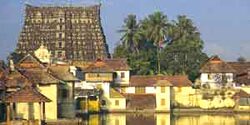 This temple, built by Raja Marthanda Varma in 1733 A.D. is a fine specimen of South Indian architecture.It is in honour of Lord Vishnu and He reclines here on Anantha the serpent. This magnificent temple tower rises in seven stories against the reflecting pool in front. This temple, built by Raja Marthanda Varma in 1733 A.D. is a fine specimen of South Indian architecture.It is in honour of Lord Vishnu and He reclines here on Anantha the serpent. This magnificent temple tower rises in seven stories against the reflecting pool in front.
|
|
The town has a history of supporting fine art and culture. The Kings of Tiruvancore (Thirunals as they are known) have not only promoted art but have themselves been accomplished artists.
The most famous of them are Swathi Tirunal who is a well known composer in both Karnataka and Hindustani styles of music, and Raja Ravi Varma the internationally acclaimed painter, well known for inventing paints using natural materials.
|
|
The town bustles with activity during Navaratri, when music festivals are held in the Sri Padmanabha Swamy Temple. Unique in its style, the temple combines the Chola and Chera styles and is large enough to conduct processions within the temple.
There is a separate quandrangle for dancers, where even the pillars are tuned and reverberate to different notes! Anantha-Padmanabha in reclined posture is a large statue, which needs to be viewed from three separate doors.
|
|
During the beginning of this century, the state had a statesman Diwan called Sir.C.P.Ramaswamy Iyer, who made women's education compulsory and free. He also allocated 15% of the state budget to education, laying the foundation for 100% literacy, which Kerala achieved quite a few years ago.
|
|
We can see vivid proof of the religious tolerance of this state - a mosque, a temple, and a church are within yards of each other at Palayam Junction.
|
|
Top
|
|
Languages and Dialects
|
|
About 96% of the people of the District speak Malayalam as their mothertongue. Only 2.5% of the people speak Tamil as their mothertongue.
|
|
As in the case of all other languages, there is some difference between the colloquial languages and the written dialect in Malayalam also. Though there is difference in the dialects spoken by the various sections and classes of the society , the fundamental unity of the Malayalam languages is not affected in any way.
The dialects spoken by the more primitive of the hill tribes differ considerably from the ubiquitous Malayalam, but they hardly deserve to be regarded as separate languages.
|
|
|
Top
|
|
Food
|
|
Rice is the staple food of the people. The Nair , Ezhavas and other such castes are not generally vegetarians, though some individual members may stick to being strict vegetarians. There is no great difference in the dietary habits of the Christians and Muslims .
The routine dietary in a family consists of breakfast , lunch, tiffin and supper. Kanji or Rice gruel with some vegetable curry and pickles formed the main breakfast until very recently in almost all families, but it has now been replaced by tea, coffee or other beverages taken along with dishes like Dosai , Idly, Poori, Chappathi and Uppuma.
|
|
The lunch is always substantial ,the most important items of the menu being cooked rice of Choru, special curries and butter milk. Parboiled rice is used here instead of Kaccha or raw is that in all culinary preparations coconut oil is freely used instead of gingelly or mustard oil used in other parts of India .
The tiffin in the afternoon consists of a cup of tea or coffee and some sweet or delicacy. The supper which is taken after sunset consists either of Kanji or similar items as for lunch.
When there was acute scarcity of rice in the wake of the Second World war, Wheat was used as a substitute for rice. Preparations of wheat such as Poori , Chappathi and Uppuma are becoming popular .
Owing to the poor cattle wealth of the District, milk is used only by richer sections of the community. Pickles of mango , cherunaranga (lime fruit ), nellikka (the fruit of phyllanthus emblica), etc ., are popular.
The condiments generally used are turmeric, pepper, ginger, cardamom , cloves , spices , chilli , mustard , onion, garlic etc. Hydrogenated oils like Vanaspathi are seldom used .
|
|
Top
|
|


